The Prop Firm Consistency Rule: The Math and What Each Firm Requires
Updated November 2, 2026
What the consistency rule is#
The consistency rule compares your best day with everything you made in the evaluation: best day divided by total profit has to stay under a percentage set by each firm. This guide summarizes it for the evaluation phase of 20 futures prop firms, as read on their official pages on October 7 and 24, 2026.
On its own, it does not cost you the account at 14 of the 18 firms that have it: their pages say that missing it means you keep trading until you meet it. Accounts are lost under other rules, such as hitting the maximum loss limit. At Elite Trader Funding, Funded Futures Network and Legends Trading, the page we read does not describe the effect, and we do not guess it here. OneUp Trader is covered further down.
The effect takes two forms. The first raises the target: if your best day goes over the limit, the effective target becomes best day divided by the limit. The second blocks the pass: the published target stays put, but even if you reach it you do not pass until your best day is back under the limit.
Both forms lead to the same total profit figure. What differs is how each firm presents it.
Do you have a funded account?
See the panel with fictitious data: how much room is left to the daily limit and the floor, in multiples of the worst real day. No sign-up.
See the panel demo →The weekly report, every Sunday
One email a week: what moved the macro picture, next week's calendar, rates and COT positioning, and the new study with its sample size. No signals; unsubscribe in one click.
The math, with examples#
There is one general formula: minimum profit = best day / limit. The limit is written as a decimal: 50% is 0.50 and 40% is 0.40.
Example: a 3,000 USD target and a 2,000 USD best day. With a 50% limit, total profit has to reach 2,000 / 0.50 = 4,000 USD. With a 40% limit, 2,000 / 0.40 = 5,000 USD. Either way, the 3,000 USD target is no longer enough.
Example, with the same target: the largest day that fits without moving anything is target × limit. At 50%, 3,000 × 0.50 = 1,500 USD. At 40%, 3,000 × 0.40 = 1,200 USD. These figures only describe the rule: they say nothing about how much to aim for or risk in a day.
The calculation updates: if a later day beats the previous best day, the formula uses the new one.
The same formula implies a floor of profitable days: 1 / limit, rounded up. At 55%, 52% or 50% that is 2 days; at 45% or 40%, 3; at 30% or 25%, 4. Earn2Trade says as much for its 30%: at least 4 profitable days, even though it declares no minimum. Other firms set a higher minimum of their own: Take Profit Trader, 3 days at 50%; TradeDay, 5 at 30%; DayTraders.com on S2L, 8 qualifying days at 25%.
The edge cases vary by firm. Take Profit Trader requires strictly less than 50% and Earn2Trade does not accept a day of 30% or more; Tradeify on Select and Goat Funded Futures on Daily Payouts accept exactly 40%. Topstep applies its 55% with no rounding. Blue Guardian Futures gives one point of leeway on the 50% of Reserve, up to 51%; Lucid Trading shows an official example of about 52% (1,560 USD of a 3,000 USD target), and DayTraders.com mentions a small tolerance without putting a number on it. The formula gives you the reference; your firm's page sets the exact number.
How it varies across firms#
Of the 20 firms reviewed, 18 have the rule in at least one evaluation plan. At 17 it is a percentage, ranging from 25% to 55%; OneUp Trader defines it differently. Apex Trader Funding and Phidias do not have it in the evaluation.
Counting firms rather than plans, with some firms appearing under more than one percentage: 40% is used by 10 firms, 50% by 9, 30% by 4, and 25%, 45%, 52% and 55% by one each.
By effect, 4 firms raise the target, 11 block the pass and 3 have no data. Within a single firm, the percentage and even whether the rule exists depend on the plan, as the lists below show.
Firms where the target goes up#
Topstep: 55% on the Trading Combine, with or without the optional daily loss limit.
Take Profit Trader: under 50% on Test. If it is not met, the target becomes more than twice the best day.
TradeDay: 30% on Quick Pay Intraday and Quick Pay EOD, and 45% on Fast Pass EOD.
FundedNext Futures: 40% on Flex. Rapid Pro and Rapid Daily do not have it in the evaluation.
Firms where you do not pass until you meet it#
Alpha Futures: 50% on Standard and 40% on Advanced. Zero does not have it in the evaluation.
AquaFutures: 50% on Flex Daily Loss and Flex No Daily Loss, and 40% on Daily. Standard does not have it in the evaluation.
Blue Guardian Futures: 50% on Reserve, with a 40% option at purchase, and 40% on Express. Standard does not have it in the evaluation.
DayTraders.com: 50% on Trail, EOD and Static, and 25% on S2L Core, S2L Edge and S2L Ultra.
Earn2Trade: 30% on Trader Career Path (TCP25) and Gauntlet Mini (GAU50).
Goat Funded Futures: 50% on Flex Challenge and 40% on Daily Payouts. EOD Challenge requires 50%, but its page does not say what effect that has. 1-Day-Pass does not have it in the evaluation.
Lucid Trading: 50% on LucidFlex and LucidDaily. LucidPro does not have it in the evaluation.
MyFundedFutures: 50% on Rapid and Pro, and 30% on Rapid EOD. Builder and the One Day add-on for Pro do not have it in the evaluation.
OneUp Trader: no percentage. On Evaluation and Pro Evaluation, the next 3 best days must add up to at least 80% of the best day. That this blocks the pass until met is our interpretation of its page.
Top One Futures: 40% on Elite Daily V2. Elite ACCESS and Elite ACCESS Intraday do not have it in the evaluation.
Tradeify: 40% on Select, with a paid add-on that takes it to 50%. Growth does not have it in the evaluation.
No data on the effect, and firms without the rule#
Elite Trader Funding: 40% on both Fast Track variants, with no effect described. The 1-Step, End of Day, Static and Diamond Hands plans are listed without a percentage.
Funded Futures Network: 40% on MAX Standard and 52% on STEADY, with no effect described.
Legends Trading: 30% on Apprentice and 40% on Elite, with no effect described.
Apex Trader Funding: no rule in the evaluation, on either EOD Trail or Intraday Trail. Phidias: no rule in the evaluation, on Express to Live, Fundamental or Premium.
Among the plans that have the rule, on some a figure from our reading was flagged as uncertain, not necessarily the percentage: AquaFutures Daily, Blue Guardian Futures Reserve at 50% with no daily limit, DayTraders.com Trail and S2L, Elite Trader Funding Fast Track, Funded Futures Network MAX Standard, Legends Trading Apprentice, OneUp Trader, one size of Top One Futures Elite Daily V2, and Tradeify Select with the add-on and Select 300K.
How to track it#
You need two figures from your own closed trades: your best day and your total profit in the evaluation. Divide the first by the second and compare the result with your plan's limit. If it is above, best day / limit gives you the total profit the rule asks for.
The platform's funded accounts panel does that math with the trades you log. You load your plan and, in the evaluation phase, you see your best day as a percentage of profit, the limit and, if you are not meeting it today, how much profit is missing. On the Free plan the panel shows only the distance to the daily limit; consistency comes with the full account, on the paid plans.
The panel uses the published percentage, without each firm's leeway, and it does not calculate OneUp Trader's rule because that rule is not a percentage. It does not say what to trade and does not promise you will pass an evaluation.
Rules change. Every figure in this guide is what was read on the date given in the sources: confirm your plan's rule on your firm's official page.
This guide summarizes rules each firm published on a specific date. It does not say which firm suits you and it is not legal or investment advice. Trading futures carries a risk of loss.
Sources (checked on October 7 and 24, 2026)#
Read on October 7, 2026:
Topstep: help.topstep.com/en/articles/8284208-consistency-at-topstep.
Take Profit Trader: takeprofittraderhelp.zendesk.com/hc/en-us/articles/15169070804125, /15169066911133, /15170265979165, /15170316538013, /15170347090461.
Alpha Futures: help.alpha-futures.com/en/articles/9492048-consistency-rule.
Lucid Trading: support.lucidtrading.com/en/articles/12945805-lucidflex-consistency-percentage, /15998336-luciddaily-consistency.
MyFundedFutures: help.myfundedfutures.com/en/articles/11994562-consistency-rule-at-my-fundedfutures.
Tradeify: help.tradeify.co/en/articles/10468320-rules-consistency-rule, /12853921-select-evaluation-accounts.
Apex Trader Funding: apextraderfunding.com/help-center/eod-accounts/eod-evaluations/.
Read on October 24, 2026:
TradeDay: tradeday.freshdesk.com/en/support/solutions/articles/103000008849-what-is-the-consistency-objective-.
FundedNext Futures: helpfutures.fundednext.com/en/articles/17230245-is-there-any-consistency-rule-to-be-followed-in-the-fundednext-futures-challenge-fundednext-account.
AquaFutures: intercom.help/aquafutures-help-center/en/articles/16934770-daily-account-rules, /16934765-flex-daily-loss-faq, /17296868-flex-no-daily-loss-faq.
Blue Guardian Futures: helpfutures.blueguardian.com/en/articles/15678716-reserve-account-rules, /15679143-express-account-rules.
DayTraders.com: intercom.help/daytraders/en/articles/17684702-trail-consistency, /17684741-eod-consistency, /17684722-static-consistency, /17697907-s2l-consistency.
Earn2Trade: help.earn2trade.com/en/articles/3849975-what-is-the-maintain-consistency-rule.
Goat Funded Futures: help.goatfundedfutures.com/flex-challenge.html, /daily-payouts.html, /eod-challenge.html.
OneUp Trader: help.oneuptrader.com/article/387-what-are-the-rules-of-the-evaluation, /389-rules-definitions.
Top One Futures: help.toponefutures.com/en/articles/15056475-elite-daily-v2-40-consistency-target-evaluation-only.
Elite Trader Funding: elitetraderfunding.app/help/consistency-rule-and-active-trade-days-atd-explained, /help/how-the-revamped-fast-track-plan-works.
Funded Futures Network: fundedfuturesnetwork.com/accounts. Legends Trading: thelegendstrading.com/plans. Phidias: phidiaspropfirm.com/rules.
Free PDF: 20 futures figures with their sample
The figures from our studies on one sheet, each with its n and date range (in Spanish for now). Subscribe to the weekly report and download it right away; the link also comes in the welcome email.
Frequently asked questions
- Does breaking the consistency rule cost you the account?
- Not on its own at the 14 firms whose pages describe the effect: you keep trading until you meet it. At Elite Trader Funding, Funded Futures Network and Legends Trading the page we read does not say, so confirm it with the firm.
- How do you calculate the profit the rule asks for?
- Best day divided by the limit. For example, with a 2,000 USD best day and a 40% limit, total profit has to reach 2,000 / 0.40 = 5,000 USD.
- Which firms have no consistency rule in the evaluation?
- Of the 20 reviewed, Apex Trader Funding and Phidias have it in no evaluation plan. At others it depends on the plan: Alpha Futures Zero, LucidPro and Tradeify Growth, for example, do not have it either.
- Does the rule also apply on the funded account?
- It depends on the firm and the plan, and the percentage can differ. As of October 7, 2026: Apex Trader Funding, 50% on the PA account; Alpha Futures, 40% on Zero and Standard Qualified; LucidPro, 40%; MyFundedFutures Builder, 50%; Tradeify Growth, 35%. Alpha Futures Advanced and LucidFlex do not have it in that phase. This guide only lists the evaluation.
These numbers, instrument by instrument
See all 30 instruments →Where this is used in Perfiltrade
- Funded accounts — The distance to each of your firm's limits, with your own history.
The calculation and its limits are in the methodology.
Take it to your chart, free
IB and gap: How often did a gap like today's fill?
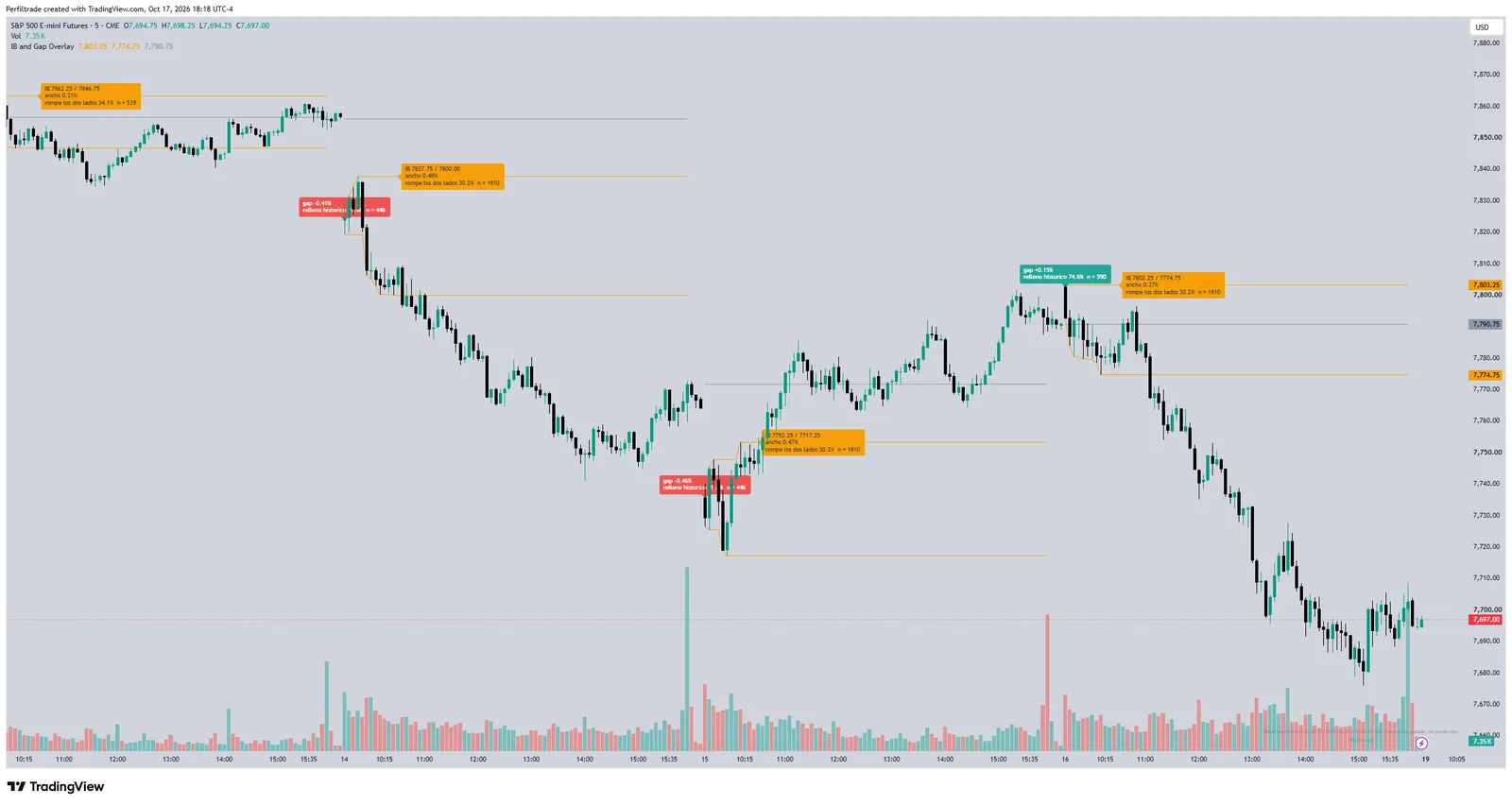
Next to the gap, how often one of that size and direction filled, with its n.
How to cite this data
The tables on this page are our own work, built from historical futures data. You may reproduce them, translate them or build on them, including commercially, as long as you credit the source and link back to the original page. If you use them, tell us: we like knowing what they get used for.
Licence: CC BY 4.0
Suggested citation:
Perfiltrade (November 2, 2026). The Prop Firm Consistency Rule: The Math and What Each Firm Requires. https://www.perfiltrade.com/en/learn/prop-firm-consistency-rule
Try these concepts with real data
14 days free, no card. An analysis tool, not investment advice.
See plans →